Community
Every interview I conducted for this research included an anecdote about recognizing or knowing someone from Twitter whom the interviewee had encountered on the street or while patronizing a local business. I, too, have had this experience in Hamilton several times, and it's this sense of community that Twitter seems to support. Community is the driving force for why this group of net-savvy, civic-minded, and engaged Hamiltonians work towards affecting change in their city. Yes We Cannon co-organizer, Justin Jones stated: "I love Hamilton. I've never felt at home in a place as I do here. And I think a lot of that really does owe to the degree to which I'm connected through both social media and more traditional means. But social media was really my foot in the door, I think, to a lot of stuff in this community." [7] Ryan McGreal, editor of Raise The Hammer, an online Hamilton civic affairs journal, spoke fondly, too, of his community when I asked about his feelings towards it.
I love the street I live on. I love the neighbourhood that I live in. I love being able to go for walk down Locke Street and kind of feeling the energy in the air. You run into somebody you know and you have a stop and chat with them. I always book a little extra time into any of my errands because I know I'm going to run into somebody and we're going to fall into a conversation. I like that about where I live. I like that I live in an actual neighbourhood where there's a real community. [8]
Critics argue that communities require strong ties, or close relationships, to exist, and that Twitter cannot foster community because it consists of too many weak ties. The terms strong and weak ties stems from the theory of the Stength of Weak Ties, developed by researcher Mark Granovetter, which in simple terms states that there are two categories of ties, "strong" and "weak", in essence, "friend" and "acquaintance", respectively [5]. Weak ties are the people you know as acquaintances—old high school friends, co-workers, friends of friends—and would not consider them to be close friends. The strength of weak ties is that they help spread information quickly; someone without a network of several weak ties would be confined to the ideas and opinions of a just a few close friends [6]. This idea can be seen in children's games, jokes, and various tales told on the playground. The same activities and stories will be retold across great distances, suggesting that they have been passed from child to child to travel such a long way—the stories have been passed on from weak tie to weak tie [6]. The same way weak ties share children's stories, they also help spread political opinion and news of civic engagement issues, bridging one group to another [5].
Communities are made up of strong and weak ties on Twitter, and the abundance of weak ties may simply be an issue of scale. David Smith supports this argument, suggesting that online social networks, such as Twitter, are "broad [weak ties] as well as deep [strong ties]" [9]. Community is a broad term and can hold many different meanings, depending on the area of research in which it is being discussed. For the purposes of this research, community is defined as:
a network of individuals connected online via Twitter, who share common geographic boundaries (the city of Hamilton), a shared interest (civic engagement), and share a certain communion amongst one another (civic pride). Further, members of the community participate in building social capital, providing help in the expectation of reciprocation, and support a culture of trust and honesty.
Weak ties often exist on Twitter because of shared interests, such as political alignment, and if two of the people in a social network have a common friend, then it is more likely that they will become friends themselves—a strong tie—in the future [3]. Strong ties require more time and effort to maintain than weak ones [6] [3] and only so many strong ties can be maintained as there are only so many hours in the day [3]; this is equally true in real life as it is for our online social networks.
Twitter is ideal for building and maintaining weak ties [4], and the more weak ties one has, the more likely they will be connected to a strong tie, increasing the likelihood of building more close friendships/strong ties over time. [3] Additionally, one can only have so many strong ties due to the efforts required to maintain those friendships in the first place. Given these tenets, and with the definition of community laid out above, it could be posited that Twitter does indeed foster community online, and given the geographic constraints of civic engagement in Hamilton, this community could extend offline as well.
According to an in-depth look at Twitter by Sysomos, a "social intelligence engine" created by computer scientists at the University of Toronto, the average Twitter user has less than 100 followers (93.6%) and follows less than 100 users (92.4%) (figure 08). A mere 0.68% has over 1000 followers and 0.94% follow greater than 1000 people. On the surface, these system-wide averages could suggest that Twitter is, in fact, a strong tie network given the high percentage of people who follow and are followed by small groups (presumably friends and family). Further to that point, less than one percent of all Twitter users are followed by or follow greater than 1000 people. The respondents to my survey, however, do not fit this average. Over half of the respondents claimed that they follow over 1000 other users, and 37.65% stated that they have more than 1000 followers. Those with followers/following counts less than 100 drop to 28.24% and 15.12%, respectively. These numbers suggest that there is a very large network of weak ties among civically engaged Twitter users in the sample studied. This argument is further substantiated by the fact that nearly half of the respondents claimed to have less than ten close friends connected to their Twitter accounts (figure 09)
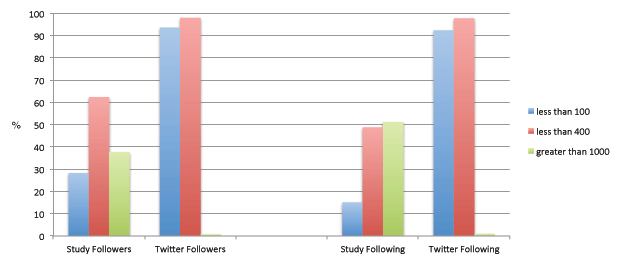
Figure 08: Respondents' Follower and Following counts compared against Sysmos findings.
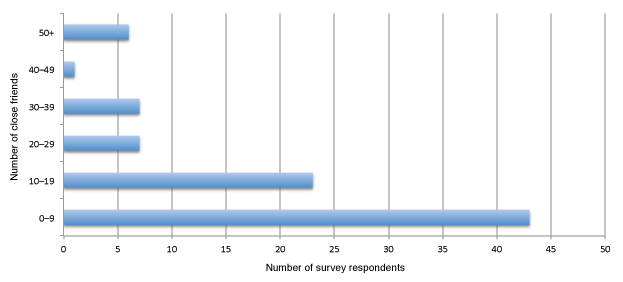
Figure 09: Number of close friends associated with respondents' Twitter accounts.
Does this mean that community can't exist online through Twitter? Anecdotal data suggests that there is a strong sense of community amongst the survey population; interviewee Justin Jones—who follows 557 users and is followed by 603— argued that Twitter was instrumental in building community when he moved to Hamilton
Twitter's been extremely helpful for me to become a part of the community. It's introduced me to a lot of the people that I know. It's introduced me to a lot of the ideas that I think are very important to community development. I think it needs to be viewed as a tool in a toolkit of building community. And I think to that extent, it's really important to recognize that it can be used to foster community if it's used in the right way. [7]
and interviewee Ryan McGreal—who follows 2,181 users and is followed by 3,361—states that "one of the things that I like about Twitter is that it has put me in contact with people right across the city, people outside of my immediate neighbourhood." [8]
Both of these individuals have higher-than-average following/follower counts which are so large that it would suggest that their networks are built from weak ties, yet they feel that community exists through Twitter, and more importantly, that Twitter fosters this sense of community.
If we assume that weak ties do not determine the strength of community, to what extent does Twitter impact community? First, it is important to understand what benefits Twitter provides that face-to-face interactions can't. Results of the survey indicate that Twitter provides users with a wider range of information and news than they would receive if they were not on Twitter. The social network also provides them with greater access and reach to members of their community, as well as more interaction and engagement with that community. Activist Joanna St. Jacques agrees, noting that "Twitter has definitely been an introduction to the community for me. I've been able to communicate all over the city, the province, and further." [10] When asked how Twitter has affected their sense of community, nearly a third of respondents said that they were more informed about their community, and several respondents also stated that they had access to a more diverse population and felt more connected to those in their community. St. Jacques believes that Twitter is "a tool for bringing people together over causes or a community," [10] and Justin Jones sums it up by saying that he uses Twitter "to better connect with [his] community" [7].
When asked about the extent to which Twitter has impacted their sense of community, the majority of respondents felt that Twitter had a strong and positive impact (figure 10). It is clear that Twitter seems to foster a strong sense of community online, but how does it affect the "real world"/offline community? Joanna St. Jacques, said that "offline, it's [Twitter that's] brought us together." [10], claiming that her offline community is stronger because of Twitter. Survey data suggests that Twitter has had a somewhat positive impact on respondents' offline communities as well, but not nearly to the same extent as their online ones (figure 11). That said, nearly one third of respondents have met more than five people offline after meeting them first through Twitter, and almost two thirds of respondents had met at least one person under the same circumstance (figure 12). The most striking argument that Twitter has a positive effect on offline communities is when looking at the time respondents spend volunteering, compared against their overall sense of community and how it is affected by Twitter. The data shows that the more impact respondents felt Twitter had on their community, and the more positive they perceived that impact to be, the more time they invested in volunteering as a whole (figure 13). This suggests that there may be a stronger effect on the offline community than respondents may recognize because, while they feel that the impact offline is minimal in comparison to the offline communities, the personal time they give back suggests otherwise.
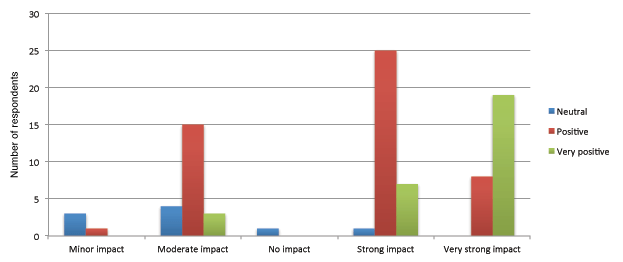
Figure 10: Respondents' sense of Twitter on their online community.
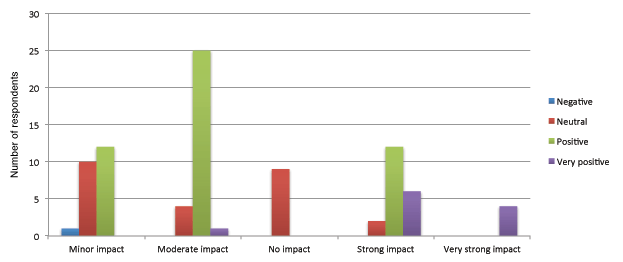
Figure 11: Respondents sense of Twitter on their offline community.
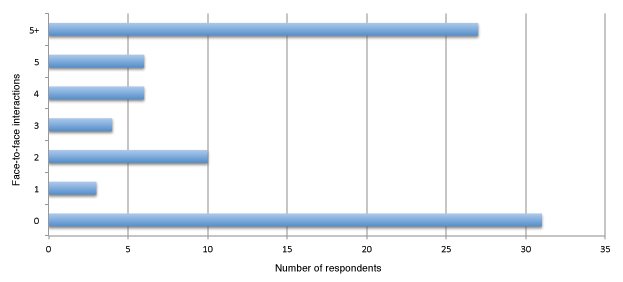
Figure 12: Face-to-face interactions after meeting on Twitter.
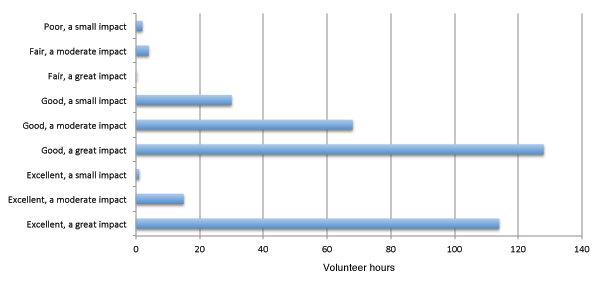
Figure 13: Hours spent volunteering based on sense of community and impact people can have on that community.
Footnote 15Six respondents explicitly stated "hugs" were a benefit of face-to-face interaction over Twitter. This simple suggestion gave the researcher "warm fuzzies" and personally validated the research.The survey shows a correlation in the data, suggesting that Twitter may be affect offline community, though to what extent is still somewhat uncertain. Regardless, one thing is clear: face-to-face interaction facilitates some things that simply can't be attained through Twitter. The respondents were clear that in-depth, detailed conversation could not be maintained through Twitter. The 140-character limit imposed by social network proves challenging to hold a true conversation. Justin Jones feels that Twitter is "a great way to start conversations and then to actually keep them going in real life and in forums that allow for a more robust discussion and community building" [7]. Respondents also noted that body language, social cues, and verbal inflection are things that are all too often lost in translation through Twitter, making terse sentences difficult to interpret properly at times. Academics agree that the 140 character text-only nature of Twitter communication limits our abilities to convey the nuanced visual cues we give in face-to-face conversation and limit our abilities to sufficiently convey emotion [1] [11]. Twitter text can clearly change the way the message is understood by the reader compared to face-to-face interactions, but "words on a screen are [still] quite capable of moving one to laughter or tears, of evoking anger or compassion, of creating a community from a collection of strangers" [11]. The most obvious benefit of face-to-face interactions is the physical contact people receive from each other. A high five or pat on the back, a warm embrace or a gentle touch all go unfulfilled online, despite an emoji's best efforts to convey such physicality. [footnote 15]
Community, according to Harold Rheingold, requires an exchange of words and ideas [11], and while Twitter facilitates this exchange, it does not require it. Users often follow multiple others without ever replying to their messages, or even reading them in the first place [3] [12]. This communication breakdown suggests that a true community cannot exist and, further, that Twitter, for this reason, cannot function as a form of public sphere. Discourse and debate are paramount to the success of the public sphere, and if no exchange takes place, can Twitter truly function as a networked public sphere? Michael Warner argues that "merely paying attention can be enough to make you a member" [13] of a public; by that measure, simply reading every tweet should constitute a member's role within the public sphere. In this case, we may be paying attention to the dialogue but there is no assurance that a debate will take place; users certainly interact with those who hold different political ideology at times, but "they very rarely share information from across the divide with other members of their community" [2]. Ultimately, it seems, politics on Twitter are extremely partisan [2].
Citations
- Boase, Jeffrey, and Barry Wellman. Personal Relationships: On and Off the Internet. The Cambridge Handbook of Personal Relationships. Cambridge: Cambridge UP, 2006: 709-723. Print.
- Conover, Michael, et al. "Political polarization on twitter." ICWSM. 2011.
- Easley, David, and Jon Kleinberg. Networks, Crowds, and Markets: Reasoning About a Highly Connected World _Networks, Crowds, and Markets: Reasoning About a Highly Connected World, Jon Kleinberg. illustrated ed. Cambridge: Cambridge University Press, 2010. Web. n.d.
- Ellison, Nicole B, Charles Steinfield, and Cliff Lampe. "The Benefits of Facebook “Friends:” Social Capital and College Students’ Use of Online Social Network Sites." Journal of Computer-Mediated Communication 12.4 (July, 2007): 1143-1168. CrossRef. Web. n.d.
- Granovetter, Mark S. "The Strength of Weak Ties." American Journal of Sociology (1973): 1360-1380. Web. n.d.
- Granovetter, Mark. "The Strength of Weak Ties: A Network Theory Revisited." Sociological Theory 1 (1983): 201-233. Web. n.d.
- Jones, Justin. Personal Interview. 6 Jun. 2014.
- McGreal, Ryan. Personal Interview. 6 Jun. 2014.
- Smith, David. "Wireless World." 27 July 2008. The Observer. LexisNexis. Academic. McMaster University, Hamilton. 22 February 2009
- St. Jacques, Joanna. Personal Interview. 3 Jun. 2014.
- Rheingold, Howard. “Virtual Worlds Research: Past, Present & Future” Virtual communities - exchanging ideas through computer bulletin boards. UC Berkeley, Stanford. July 2008. Vol.1, issue 1
- Takhteyev, Yuri, Anatoliy Gruzd, and Barry Wellman. "Geography of Twitter Networks." Social Networks 34.1 (2012): 73-81. Web. n.d.
- Warner, Michael. "Publics and counterpublics." Public culture 14.1 (2002): 49-90.