Civic Engagement
Twitter is, essentially, a soapbox: the one-to-many broadcast network allows anyone and everyone with Internet access to share their thoughts, feelings, and opinions. In the case of the Dialogue Partners fiasco, a simple tweet—"Anyone remember #TellVicEverything? Let's try strategy with @OurHamilton. Maybe #TellOHEverything?"—from Twitter user Michael Pett inspired a "spontaneous movement that sprang up because one person said just the right thing and posted it to Twitter at the right moment" [9]. Less than 24 hours later hundreds of individuals had joined the movement, sharing fake, and often amusing, facts about Hamilton to the Dialogue Partners' @OurHamilton account. The idea was shared, the people saw it, and they engaged.
Critics question whether engaging in politics through Twitter is truly participating; posting tweets or retweeting a political message only shows awareness and not necessarily action [1]. This low effort approach to civic engagement is commonly referred to as "slacktivism" and, while critics feel it does not directly create change, some believe that slacktivism helps the cause by bringing more attention to the movement, by helping spread the word. [12] [14] [3] Although slacktivism may be seen as a form of armchair activism, the case studies discussed in this research suggest that it can be effective in creating change.
Retweets in support of a movement may be of concern for some users who worry about being linked to a particular group or cause. The worry of being identified is of increasing concern when the risks are higher, such as in movements like the Arab Springs. Twitter provides potential anonymity to these users by removing the necessity to disclose age, gender, or race, ultimately providing an opportunity for everyone to participate as equals. [5] [12] [2] Removing these social barriers creates a horizontality within the movement that may not exist with traditional media. This democratization lowers the barrier for entry among potential protesters and allows everyone the chance to participate [6], resulting in a lack of clear leadership; today's protests may not be represented by a single persona like Martin Luther King Jr. was for the American Civil Rights Movement decades earlier. The multitude of voices replaces the need for a leader and makes it easier for everyone to collaborate, coordinate, and share their opinions [8].
Footnote 09Raise the Hammer's account sat between Coleman and Babcock in the rankings, but it is an organizational account, rather than an individual, so it was not included in this discussion.This inherent lack of leadership is apparent in the Dialogue Partners fiasco case study, where a group of individuals came together to effect change "without anything of what you would consider a traditional organizational structure behind it" [10]. McGreal, an individual who has been involved at various levels of multiple movements in Hamilton believes that "[the] idea that campaigns have leaders is a bit of a misnomer; I think people either care enough to get involved or they don't. And if they do care, and if there's somebody there to facilitate that, then it happens. It's like a piece of string; you can't push on it" [10]. Although it is true that the Dialogue Partners campaign was not organized by any particular individual(s), it is clear that some voices were louder than others in the Twittersphere the night of January 7, 2013. Community members Joey Coleman and Laura Babcock tweeted significantly more than the other 605 people who posted using the #tellOHEverything hashtag. They were also the most retweeted, and ultimately, had the most significant reach out of any participants to the movement [footnote 09]. As community activist, Joanna St. Jacques explained, "You can be a voice in the crowd or one strong voice in a crowd." [14]
A horizontality among activists may indeed exist—as it does in the Dialogue Partners fiasco case study—but this levelled playing field does not include equal representation from all socioeconomic groups. It is important to note that Hamilton's civically engaged Twitter population appears to be made up primarily of well educated, high-income earning white residents. There may well be a horizontality amongst those participating in civic engagement on Twitter, but at the core, there is still a clear lack of equal representation (see section on digital divide).
The PEW Research Center report on Civic Engagement in the Digital Age states that the well-educated and the well-off "have always been more likely to be active in politics and community affairs offline" [13], but it is clear to those engaged in politics and civic engagement that things are changing. Yes We Cannon organizer, Justin Jones, believes that "Twitter is really becoming the forum for political engagement, in at least in that superficial way and then when you really want to dig down you need to move this conversations offline. I think its a great place for people to get that first taste of engagement." [8] City of Hamilton councillor, Sam Merulla agrees: "[Twitter is] more superficial in nature, but I think it allows me to start the discussion, which then can be expanded upon in forums such as Facebook." [11] This superficiality is a growing concern regarding civic engagement on social media networks, like Twitter, because participants may not be truly committed to the cause. There is no doubt that some Twitter users' engagement may be halfhearted, but it does not mean that social media cannot be used effectively for social change; even slacktivism can help the cause by bringing more attention to the movement by spreading the word of the movement through retweets [12] [15]. Ultimately there is an exponential number of potential protesters watching the goings-on surrounding the movement, increasing the likelihood for a larger than expected turnout on the day of protest [3]. These part-time activists have greater agency over when and where they choose to physically participate in a movement.
Footnote 10The Facebook event page has 34 confirmed attendees for the Yes We Cannon bike parade, and the Spectator newspaper refers to "dozens" of participants.The Dialogue Partners fiasco occurred solely online. No protest or march ever took place. The sudden and spontaneous rise of the movement, the fact that many of the tweets were in jest, and that the majority of participation came from retweets, suggests that the movement not only had an active group of slacktivists, but that the protest was founded on slacktivism. The Yes We Cannon movement had over 2300 people sign an online petition in support of the Cannon Street bike lanes, but when organizers planned a "bike parade" down Cannon Street in June 2013, only a handful of cyclists came out in support [footnote 10]. This lack of physical representation suggests that the Yes We Cannon movement saw a large percentage of slacktivist participation, too, yet both movements succeeded in their respective goals.
A snapshot of slacktivism in Hamilton shows that a large majority of respondents use Twitter for politics, although just over half feel that they belong to a political or social issues group (figure 01a–b), suggesting that they may not be fully engaged participants in local political movements. Further to that point, less than half of the respondents reported participating in the Hamilton-specific causes listed in the survey even though they knew of them (figure 02) —yet an overwhelming majority have used Twitter to share their political beliefs in some way (figure 03a–e).
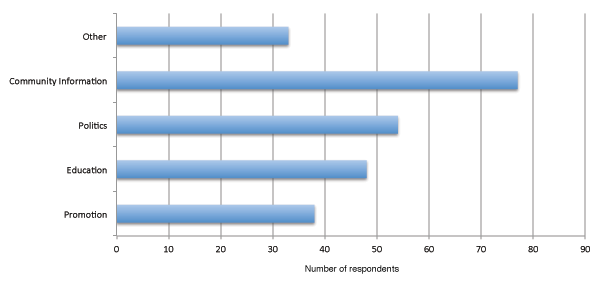
Figure 01a: How survey respondents use Twitter.
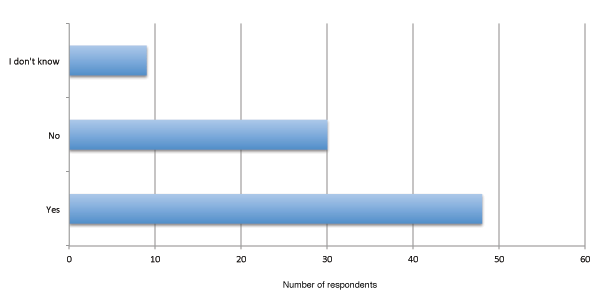
Figure 01b: Survey respondents that belong to a group through Twitter that is involved in political or social issues, or that is working to advance a cause.
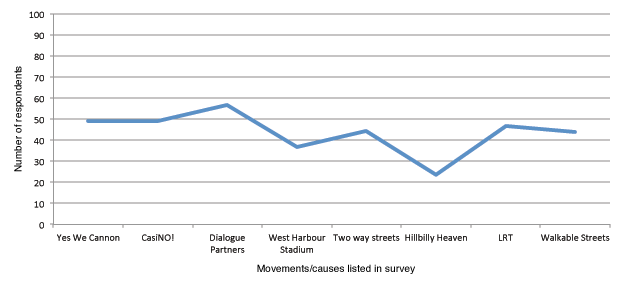
Figure 02: Survey respondents' awareness of movements/causes in Hamilton.
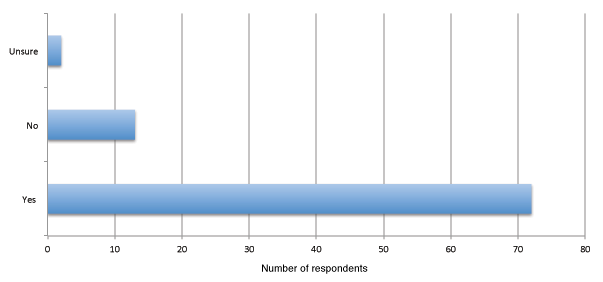
Figure 03a: Respondents who use Twitter to follow an elected official, candidate for office, or other political figure(s) in Hamilton.
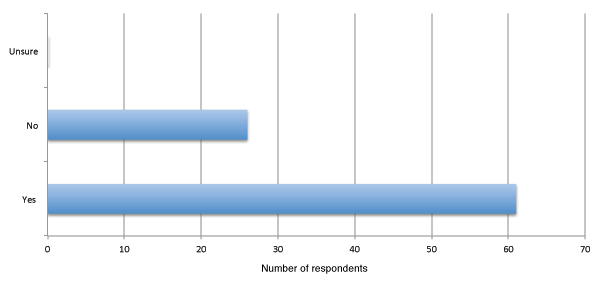
Figure 03b: Respondents who use Twitter to post links to political stories or articles for others to read on Twitter.
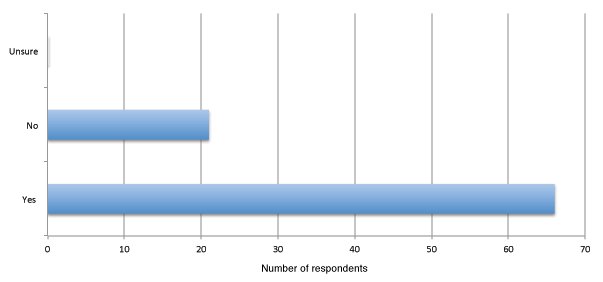
Figure 03c: Respondents who post their own thoughts or comments on political or social issues.
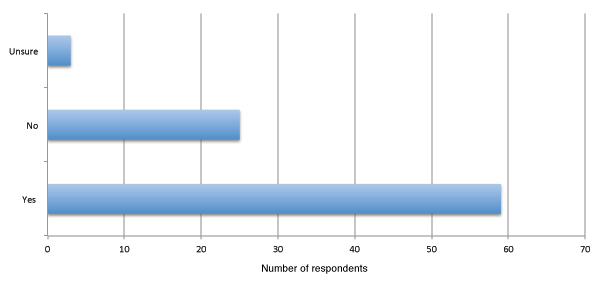
Figure 03d: Respondents who have used Twitter to encourage other people to take action on a political or social issue that was of importance to them.
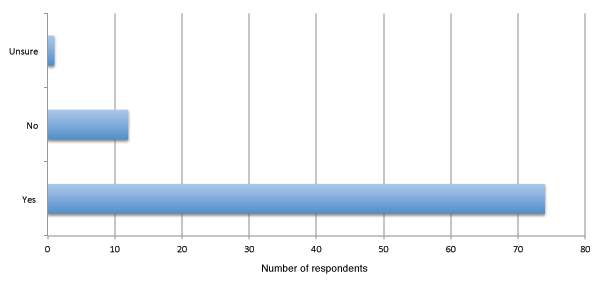
Figure 03e: Respondents who have used Twitter to retweet material related to political or social issues on Twitter.
Critics of slacktivism argue that it is too easy to share information via social media, and that messages are often hearsay [4]. Journalist Malcolm Gladwell pointed out that the vast majority of tweets during the Arab Spring came from the West and were written in English instead of local dialects such as Farsi [4]. In the case of the Dialogue Partners fiasco, several rumours were circulated on Twitter, stirring the pot and inciting more upset. Messages via social media may not always be truthful or accurate, but they are always human. This hint of human emotion gives greater legitimacy to the messages being sent and can foster sympathy from those not involved. These broadcasts, truthful or not, can help shape the narrative of the protest, especially since they are seen as coming from the ones engaged in the movement. Slacktivism may not create true engagement, but it can help the movement, perhaps only for the reason that it may superficially inflate the size of the crowd.
Continue reading: Digital Divide
Citations
- "#Occupytheweb." The Economist. The Economist Newspaper Limited, 11 Oct. 2011. Web. 13 Oct. 2013. Web. n.d.
- Chebib, Nadine Kassem, and Rabia Minatullah, Sohail. “The Reasons Social Media Contributed to the 2011 Egyptian Revolution”. International Journal of Business Research and Management 2.3 (October 2011): 139-62. Web. n.d.
- Faris, David M. Dissent and Revolution in a Digital Age: Social Media, Blogging and Activism in Egypt. London: I.B. Tauris, 2013. Web. n.d.
- Gladwell, Malcolm. "Small change." The New Yorker 4.2010 (2010): 42-49. Print.
- Hanson, Jarice and Alina Hogea. "The Internet as the Public Sphere: Deliberative Democracy and Civic Engagement." E-Governance and Civic Engagement: Factors and Determinants of E-Democracy. IGI Global, 2012. 467-486. Web. 21 Feb. 2014.
- Hardt, Michael, and Antonio Negri. "The Fight for 'Real Democracy' at the Heart of Occupy Wall Street." Foreign Affairs. (October 11 2011). Web. 13 October 2013.
- Hounshell, Blake. "The revolution will be tweeted." Foreign policy 187 (June 29 2011): 20-21. Print.
- Jones, Justin. Personal Interview. 6 Jun. 2014.
- Mansour, Essam. "The Role of Social Networking Sites (SNSs) in the January 25th Revolution in Egypt." Library Review 61.2 (2012): 128-159. Web. n.d.
- McGreal, Ryan. Personal Interview. 6 Jun. 2014.
- Merulla, Sam. Personal Interview. 5 Jun. 2014..
- Schmidt, Eric, and Jared Cohen. The New Digital Age: Reshaping the Future of People, Nations and Business. Random House Digital, Inc., 2013. Print.
- Smith, Aaron. ["Civic engagement in the digital age."](http://www.pewinternet.org/2013/04/25/civic-engagement-in-the-digital-age/) Pew Internet & American Life Project (2013).
- St. Jacques, Joanna. Personal Interview. 3 Jun. 2014.
- van Stekelenburg, Jacquelien. "The Occupy Movement: Product of This Time." Development 55.2 (2012): 224-231. Web. n.d.
- Wellman, Barry., and Caroline A Haythornthwaite. The Internet in Everyday Life. Malden, MA: Blackwell Pub., 2002.