Digital Divide
Joanna St. Jacques, an activist fighting to keep local schools open around Hamilton observes "The Twitter community is pretty powerful. We brought together 1200 people through different petitions. Now we interact on a fairly regular basis." [7] There is no argument that Twitter is a powerful mobilization tool for activists, but as seen in the Dialogue Partners fiasco example earlier, there is concern over who is engaging with these movements online. There is concern that lower income families and racialized minorities are not represented [9] equally on Twitter. This imbalance of demographic representation is often referred to as the "digital divide". Critics fear that leaving lower-income citizens out of the debate provides a way for "'net-savvy' special interest communities... [to] pursue their own agenda at the cost of the public commonweal" [9]. The survey data collected for this study suggests that there is a very real and very distinct digital divide in the city of Hamilton. This should be of concern, not just to the city's politicians listening to the Twitter voices, but to the activists themselves, as they may not actually be affecting change for the "common good".
The digital divide is a term used to define the imbalance between individuals who are marginalized—by income, gender, race, or sexual orientation [9]—and those who are not. Essentially, it is "[the] difference between the haves and have nots" [9] when it comes to access to the Internet. The "haves" are typically male, white, urban, high income earners, and highly educated, but in North America, Internet access is almost evenly split amongst men and women [9]. This gender equality is further supported by statistics that show women account for 53% of Twitter's user base [2] and the fact that 52.3% of the respondents to the survey were women. To be clear, the digital divide is not a hard line, but rather a shifting gap between these various groups of individuals [8] as each group has different needs and expects different outcomes from the Internet [9].
Footnote 11Hamilton's low-income families account for 14.3% of the population, compared to 11.7% for the provincial average. The unemployment rate sits at 6.8%, compared to 7.4% provincially. 16.4% of the population is employed in manufacturing.Footnote 12The Strathcona neighbourhood (postal code L8R) has seen an 87% increase in housing prices over the past decade. Strathcona is centrally located between up-and-coming and gentrified areas like Westdale village, Locke Street South, and James Street North. It is also close to several city medical facilities, McMaster University, and McMaster's Innovation park (a premiere research park). Lastly, Strathcona abuts Highway 403, providing easy access to Toronto. These landmarks suggest that Strathcona is an ideal location for a well-educated person looking to earn a high income locally or with easy access to a job in the GTA.Hamilton has a higher-than-average number of low-income families and a large contingent of blue-collar workers [footnote 11], many of whom have been forced out of their manufacturing jobs at employers like the local steel mills. At the same time, the city is seeing an influx of residents from the Greater Toronto Area looking for affordable housing within the city and is becoming a haven for people commuting to Toronto for work (effectively a bedroom community) [footnote 12]. These two distinctly different groups of residents would seem to be making the city diverse, but the diversity is not found on Twitter. Although some research shows the digital divide to be shrinking [9], within Hamilton's Twitter population, political discussion is dominated by individuals who represent the quintessential "haves".
Footnote 13The Postal codes/Forward Sortation Areas most densely occupied by respondents also happens to be in the midst of gentrification. Hamilton's gentrification is moving West, from the Westdale neighbourhood, East.Analysis of the Twitter population that responded to the survey shows a pronounced digital divide. Breaking down the statistics, based on the definition of digital divide noted above, the population studied is evenly balanced between males (46.5%) and females (52.3%), as is the norm in North America. A mere 2.3% of the respondents identify as a visible minority, making the vast majority of the population of this study white. A review of respondents by postal code shows that the majority of respondents live in the lower city of Hamilton, specifically in the downtown (urban) core [footnote 13]. Even when the number of respondents is compared against 2011 census data for Forward Sortation Area populations (which are identical to the first three digits of Canadian postal codes), there is a clear predominance of responses from these urban areas(figure 04a–b).
Additionally, a comparison of household income against family size shows a very striking number of Hamiltonians who live well above the national poverty line, the majority of which earn $70,000+ (figure 05). Finally, there is a large contingent of respondents who are highly educated and have earned a university degree or higher. The level of education among respondents is noticeably higher than the provincial average when compared to the 2012 Statistics Canada Canadian Internet Use Survey (figure 06). Combined, these correlations suggest a very pronounced digital divide in Hamilton, in regard to those who are interested in civic engagement via Twitter.
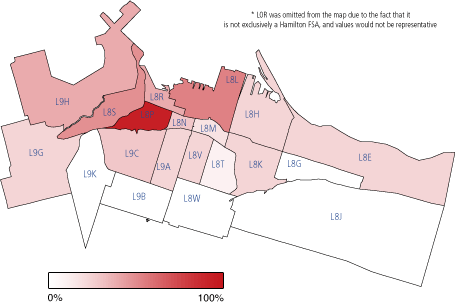
Figure 04a: Survey responses by postal code.
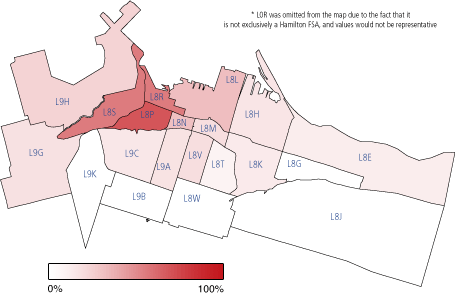
Figure 04b: Survey responses by postal code, averaged against 2011 census data for Forward Sortation Area populations.
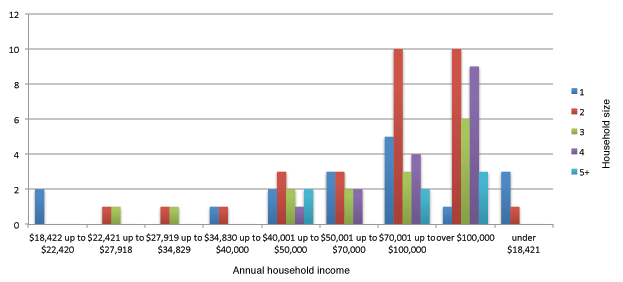
Figure 05: A comparison of household income against family size amongst survey respondents.
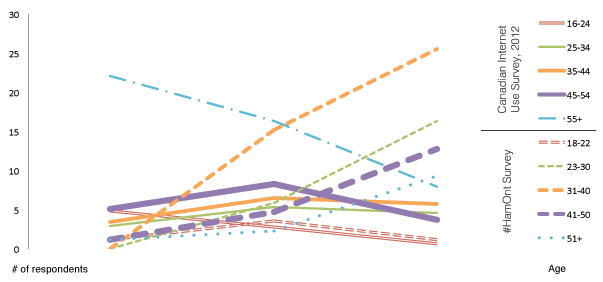
Figure 06: Education levels among respondents compared against the 2012 Statistics Canada Canadian Internet Use Survey results.
A 2013 PEW Internet survey on Civic Engagement in the Digital Age claims that "[t]raditional political activities are most common among the well-educated and financially well-off, regardless of whether they take place online or offline. On social networking sites, income-related differences are more modest — but civic engagement in these spaces is still most prevalent among those with higher educational levels." [6]. This seems to be reflected within the survey data collected; while the household income is significantly high for the upper-middle class, there does appear to be some representation from each household income bracket, suggesting that while the dominant representation is from financially well-off families, there is also notable representation from other income levels (figure 07). Adding to the PEW argument, the sample population seems to have a higher-than-average group of well-educated individuals.
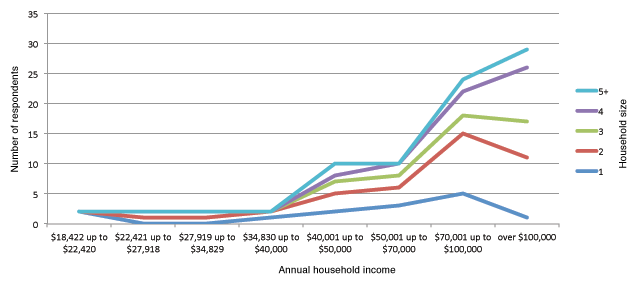
Figure 07: Representation of household income brackets.
A concern over the persisting digital divide is that the those at the upper end of the socio-economic scale can dominate public discussion, opening the possibility for net-savvy special interest groups to control the political agenda [9]. This concern is realized when the Dialogue Partners fiasco and Yes We Cannon movements are considered. The Twitter users involved in the Dialogue Partners fiasco movement persuaded city council to cancel a $376,000 contract , but only 607 people tweeted or retweeted posts on Twitter to the #tellOHEverything hashtag—just over 0.1% of the total population of Hamilton. An extremely small percentage of the population, in a matter of hours, convinced city hall to cancel the PR firms contract, despite $242,000 of the contract already being paid. This suggests that participation on Twitter begets change, but for a extreme minority of the population. The Yes We Cannon campaign saw roughly four times the participation that the Dialogue Partners fiasco saw, but that still only accounts for roughly 0.5% of Hamilton's population. Again, an extremely small portion of the overall population convinced the local government (who voted unanimously in favour of the bike lanes) to make significant change to the city’s infrastructure, a historically controversial issue. Although critics of these initiatives worry that they advance priorities held by only a tiny minority, another possibility, especially given the extensive research showing the benefits of complete streets to a wide range of people, is that this small group of civically engaged citizens has a distinctive ability to influence change for the common good.
Footnote 14McGreal came in second when respondents were asked to name "influential members in [their] community".The survey data suggests a strong digital divide in the city of Hamilton, and there are genuine concerns that a small group of individuals can control the politics of the city. Ryan McGreal, editor of Raise The Hammer, an online Hamilton civic affairs journal, and one of the most influential individuals in the city [Footnote 14] believes that Twitter "is a middle class conceit; it's a privilege" [5]. As another Hamilton resident points out, "Twitter users in Hamilton simply do not represent the much wider and demographically diverse communities of our city." [1] This concern limits the effectiveness of Twitter as a form of networked public sphere. Nancy Fraser points out that "the media that constitute the material support for the circulation of views are privately owned and operated for profit. Consequently, subordinated social groups usually lack equal access to the material means of equal participation." [4] To apply Fraser's argument to this case: while Twitter may be free to join, the cost of getting online may be too high for lower-income families and individuals. This barrier-to-entry may hinder new immigrants, less-educated individuals, the unemployed, and others from participating in public discourse. Twitter, as a platform may be open and accessible to all, but because it must be accessed through a larger infrastructure—the Internet—it can fail to be accessible, leaving Twitter to be dominated by a group of like-minded, similar individuals (high-earning, well-educated, white), much like Habermas’s bourgeois public sphere.
Citations
- Butani, Mahesh P. "Does Hamilton's Twitter Universe Represent the Whole City?" Metropolitan Hamilton. n.p. 22 Jan. 2013. Web. 13 Aug. 2014.
- Cheng, Alex, and Mark Evans. "An In-Depth Look at the 5% of Most Active Users".. Sysmos Resources. Sysmos. Aug. 2009. Web. 13 Aug. 2014
- Craggs, Samantha. "Sold! How a hot real estate market is changing Hamilton." CBC Hamilton. Canadian Broadcasting Corporation. 3 Sep. 2013. Web. 13 Aug. 2014.
- Fraser, Nancy. "Rethinking the public sphere: A contribution to the critique of actually existing democracy." Social text (1990): 56-80.
- McGreal, Ryan. Personal Interview. 6 Jun. 2014.
- Smith, Aaron. "Civic engagement in the digital age." Pew Internet & American Life Project (2013).
- St. Jacques, Joanna. Personal Interview. 3 Jun. 2014.
- Van Dijk, Jan AGM. "Digital divide research, achievements and shortcomings." Poetics 34.4 (2006): 221-235.
- Wellman, Barry., and Caroline A Haythornthwaite. The Internet in Everyday Life. Malden, MA: Blackwell Pub., 2002.